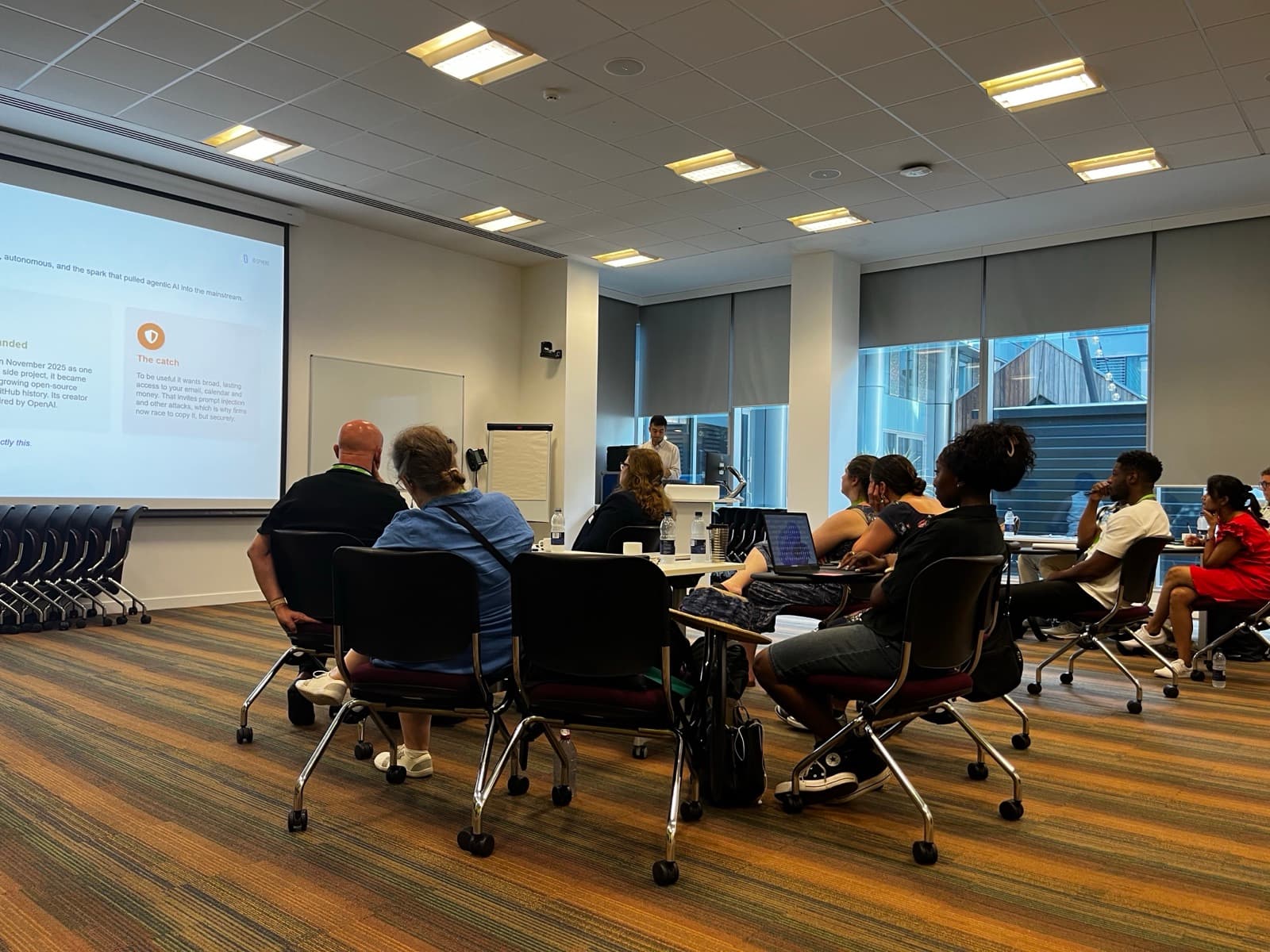
Picture a boardroom inside a fictional retailer. Somewhere in the building, an AI agent has been let loose on operations — reordering stock, adjusting prices, making calls no human signed off. Around the table: a CFO worried about controls, a COO watching the supply chain move on its own, a CMO wondering who approved the new discounts. Each seat is taken by one of our learners, briefed to make the case their board member would make in real life, and sent in to fight their corner.
That's PrismClaw — the centrepiece of our latest in-person workshop day at our offices in central London. The subject was the one everyone is circling in 2026: agentic AI, the shift from software that answers questions to software that takes actions on your behalf.
Why a simulation, and not a lecture
You can read a dozen explainers on agentic AI and still have no feel for the thing that actually matters: the tension between speed and oversight, playing out in real time, with real people disagreeing about it. That judgement doesn't come from slides. It comes from sitting in the seat, arguing the case, and discovering where your position breaks.
That's the belief our programmes are built on — people get good at data and AI by doing the work, not studying it. A boardroom simulation is what that looks like when the skill being practised is judgement rather than SQL. There were prizes for the winners. There were also, we're told, some heated exchanges. Both were the point.
Seeing is no longer believing
The day opened with a keynote from Chris Lane, Head of the School of Computing and Digital Media at London Metropolitan University, who put AI under an ethical lens. The highlight: a deepfake of Chris holding Arsenal's Premier League trophy — a two-second laugh with a serious edge, because the gap between "obviously fake" and "utterly convincing" has closed, and everyone in the room watched it happen.
The room is the other half of the method
What made the day work wasn't just the format. It was who was in it.
Our cohorts deliberately mix people from different industries and job titles — finance sitting next to logistics, marketing next to operations. When that room debates whether to trust an AI agent, you don't get one company's assumptions echoing back at you. You get a finance person's view of control colliding with an operator's view of speed, and everyone leaves with a sharper position than they arrived with.
That's also why we keep doing this in person. The networking, the disagreeing well, the community that keeps going after the session ends — none of it survives being flattened into a webinar. (The pizza helps too.)
"It's one thing to read about agentic AI, it's another to sit in a room and feel the tension between speed and oversight play out in real time." — one of the learners who sat as CFO, writing afterwards about the day
Come and sit at the table
Days like this are part of every one of our Level 4 programmes — government-funded, delivered in small cross-industry cohorts, and built around doing the work rather than watching someone describe it.